
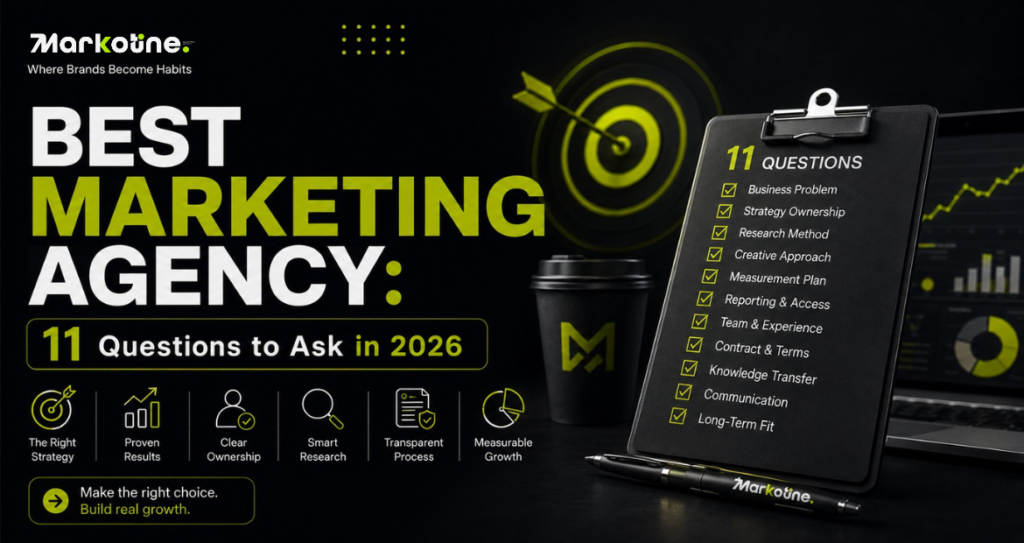
Best Marketing Agency: 11 Questions to Ask in 2026
Typing best marketing agency into Google usually means you are already past the awareness stage. You are not looking for a definition of marketing; you are trying to reduce the risk of choosing the wrong partner. A universal procurement-style guide built around the eleven questions a serious buyer should ask before signing. This guide is designed to help a buyer make that decision without treating an SEO title as an objective ranking.
The buyer’s real risk
“Best” is contextual: a launch, turnaround, lead-generation program and brand-building mandate require different agency strengths. The commercial implication is simple: the agency has to understand how demand is created, how trust is earned and what happens after a click or message. If it cannot connect those stages, you may receive plenty of activity without a reliable growth system.
The fastest way to shortlist
Digital marketing works best when strategy, creative, distribution, measurement and conversion are treated as one system rather than separate tasks.
A serious agency should be able to show the operating logic behind the service: inputs, decisions, outputs and feedback. That is more useful than counting deliverables in isolation.
The first question
Start with what business problem is being solved. Ask the agency to explain how this appears in its weekly work, who owns the decision and which signal tells the team to adjust. That matters because a dashboard can look healthy while the commercial outcome stays flat. For best marketing agency, this turns a vague capability into something you can actually compare.
One useful test is who owns strategy. Do not accept a slide that only says the agency ‘does’ it. Ask what inputs are reviewed, what a good result looks like and what happens when the number moves in the wrong direction. A mature team can describe the tradeoff, show the data it uses and tell you what would make it change direction.
The second question
Pay close attention to how research is done. This is often where two agencies with similar service lists produce very different outcomes. The stronger team will connect the activity to a customer behavior or business metric, then show how the learning affects the next campaign cycle.
Treat what will be measured as an operating question rather than a checkbox. Who does the work? How often is it reviewed? What is documented? How does it change budget, creative or sales follow-up? Those answers reveal more than a portfolio screenshot.
The third question
A practical comparison point is how experiments are prioritized. If the agency cannot explain the decision in plain language, the process may be more reactive than strategic. Look for a repeatable method, clear ownership and a feedback loop that reaches the business outcome.
Start with who produces creative. Ask the agency to explain how this appears in its weekly work, who owns the decision and which signal tells the team to adjust. That matters because a dashboard can look healthy while the commercial outcome stays flat. For best marketing agency, this turns a vague capability into something you can actually compare.
What to verify in the account
One useful test is how account access works. Do not accept a slide that only says the agency ‘does’ it. Ask what inputs are reviewed, what a good result looks like and what happens when the number moves in the wrong direction. A mature team can describe the tradeoff, show the data it uses and tell you what would make it change direction.
What to verify in the contract
Pay close attention to what happens when results fall. This is often where two agencies with similar service lists produce very different outcomes. The stronger team will connect the activity to a customer behavior or business metric, then show how the learning affects the next campaign cycle.
Treat how scope changes as an operating question rather than a checkbox. Who does the work? How often is it reviewed? What is documented? How does it change budget, creative or sales follow-up? Those answers reveal more than a portfolio screenshot.
A practical comparison point is how knowledge is transferred. If the agency cannot explain the decision in plain language, the process may be more reactive than strategic. Look for a repeatable method, clear ownership and a feedback loop that reaches the business outcome.
Start with how success changes over time. Ask the agency to explain how this appears in its weekly work, who owns the decision and which signal tells the team to adjust. That matters because a dashboard can look healthy while the commercial outcome stays flat. For best marketing agency, this turns a vague capability into something you can actually compare.
How to run a low-risk pilot

Before signing, ask the agency to walk through one realistic scenario for your business. What would it do in the first two weeks? Which assumptions would it test first? What data would it need from you? What result would cause it to increase budget, change creative or pause a channel? The quality of this explanation often reveals more than the presentation deck.
Also ask for a sample report with client details removed. Look for interpretation, not just charts. A useful report explains what changed, why the team thinks it changed, what is still uncertain and which decision comes next. If every month ends with the same list of metrics, the agency may be reporting activity rather than managing learning.
Final verdict
Be cautious with guarantees that ignore context: fixed ROAS before seeing margins, guaranteed rankings on a deadline, or promises of a specific lead cost before tracking and sales quality are understood. Other red flags include ad accounts owned by the agency, vague production limits, hidden software costs, and reports that stop at clicks or reach.
The best commercial relationship is transparent about what the agency controls and what it does not. Product-market fit, pricing, sales speed, stock, operations and customer experience can all affect marketing performance. A mature partner surfaces those dependencies early instead of using them as excuses later.
What a strong first 90 days can look like
A useful first month is usually diagnostic: clean the measurement setup, understand the customer journey, review existing creative and identify the biggest conversion constraint. The second month should produce enough controlled tests to reveal patterns around what business problem is being solved; who owns strategy; how research is done; what will be measured. By the third month, the team should be concentrating resources on what is working and documenting what it has learned.
This sequence is intentionally different from buying a fixed monthly package forever. The deliverables can remain consistent, but the decisions should evolve. If the same plan is repeated after new data arrives, the agency is not really optimizing.
A final way to think about best marketing agency is as a fit problem rather than a popularity contest. The useful agency is the one whose strengths match the next constraint in your growth system.
Final takeaway
The phrase best marketing agency is useful for finding candidates, but it cannot choose a partner for you. Use the search to build a shortlist, then judge strategic depth, execution quality, measurement, ownership and commercial fit. The right agency should make your decisions clearer, not simply make your marketing busier.
For Markotine, the standard should be the same: compare the proposed process against the criteria in this article, ask how the work connects to a business outcome and insist on transparent access to the accounts and data that belong to your company.
Frequently Asked Questions
How should I compare agencies targeting Core Agency Intent?
Give each agency the same brief and score the response on market understanding, strategic logic, proof, measurement, team quality and commercial clarity. Comparing the same questions is more useful than comparing package names.
Should I choose the cheapest proposal?
Not automatically. First normalize the scope: seniority, production, media management, tracking, reporting and revision limits. A cheaper retainer can cost more if it produces weak data or low-quality leads.
How long should I test an agency?
Set decision points rather than one universal deadline. Paid media can reveal useful signals quickly, while SEO, brand building and lifecycle programs need more time. Agree on leading indicators and review dates before the engagement starts.